

This guide walks families through options with clarity, respect, and actionable insight.
💡 What Is Burial or Final Expense Insurance — and Why It Matters
Final expense insurance is a simplified whole-life policy, usually ranging from $2,000–$50,000. For seniors, especially those with health concerns like mild to moderate COPD, diabetes, or a history of cancer, it’s often the most affordable and accessible option.
Key benefits:
- No medical exam required — just a few health questions for simplified issue policies.
- Locked-in premiums that don’t rise with age.
- Lifetime benefits that never decrease
- Payouts that aren’t delayed when you qualify for simplified issue coverage.
For families on fixed incomes or middle-income seniors, these policies offer peace of mind with minimal hassle, ensuring funeral costs and other expenses won’t burden loved ones.
🔍 Plan Types: Understanding Your Options
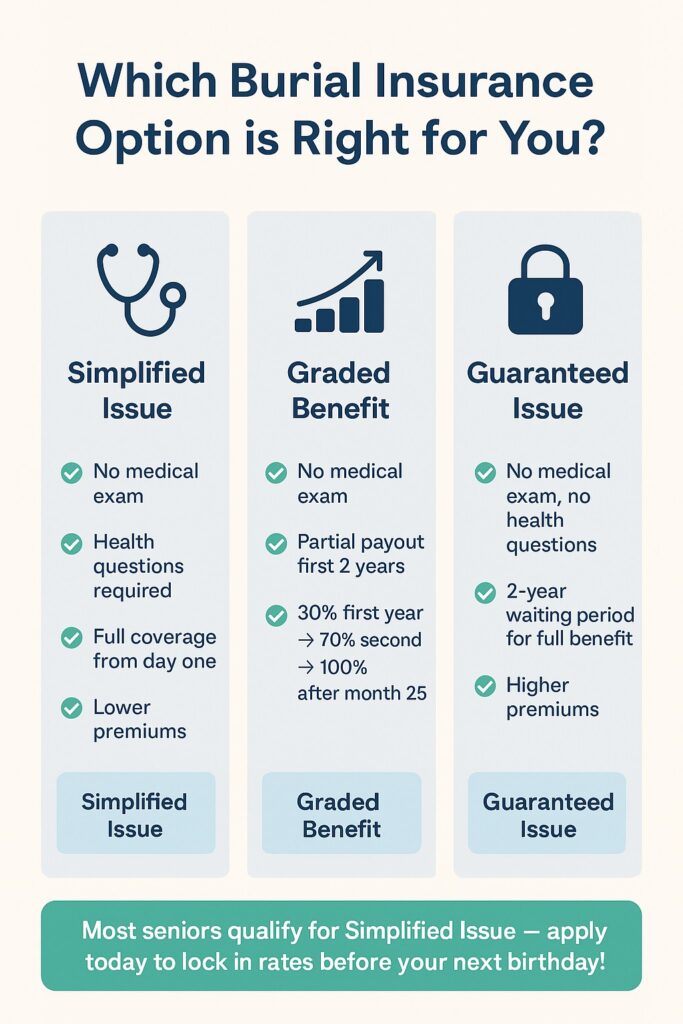
| Plan Type | Health Questions? | Waiting / Graded Period | Death Benefit from Day One? | Typical Cost |
|---|---|---|---|---|
| Simplified Issue | Yes, a few limited questions | None | ✅ Full benefit immediately | Usually much lower than Guaranteed Issue; may be slightly higher for tobacco users |
| Guaranteed Issue | No | 2–3 years for natural death; accidental death paid immediately | ❌ Full natural death benefit delayed | Highest premiums; safety net only |
| Graded Benefit | Yes | Partial benefit first 24 months (5–30% year one, 50–70% year two), full benefit begins 25th month | ❌ Partial initially, 100% after graded period | Often better value than Guaranteed Issue for greater health concerns |
| Modified Policy | Yes | Short limited period with reduced payout | Partial at first | Higher cost; usually only if other options aren’t available |
Key Takeaways:
- Simplified Issue: Full coverage from day one; usually lower premiums. This is the ideal burial insurance plan for elderly people.
- Guaranteed Issue: No health questions; higher cost and delayed full payout (2 years). Designed for very poor health.
- Graded Benefit: Partial benefits for two years, full at 25th month; better value than Guaranteed Issue for many seniors.
- Modified Policy: Only for higher-risk applicants; expensive coverage. Includes a common 2-3 year graded period. Very few companies offer a good value in this type of burial insurance.
💰 Typical Costs of Burial Insurance for Seniors
Funeral expenses in 2026 average $7,500–$12,000, depending on location and service choices. Without planning, your family may have to cover these costs.
Approximate monthly premiums for simplified coverage for a male non-tobacco user:
| Coverage | Age 60 | Age 70 | Age 80 |
|---|---|---|---|
| $5,000 | $23/mo | $36/mo | $70/mo |
| $10,000 | $36/mo | $70/mo | $135/mo |
- Smokers or those with certain health conditions may pay slightly higher rates.
- Guaranteed Issue is more expensive because no health questions are asked.
- Acting sooner locks in lower premiums before birthdays push you into higher age brackets.
Burial Insurance for Seniors Over 80: What Changes?
Can you still get burial insurance after age 80? Yes—but the market becomes very different as you get older. There are fewer insurance companies willing to offer coverage, premiums increase, and your health and exact age become increasingly important in determining what is available.
That doesn’t mean you’re out of options. It means that after 80, burial insurance is less about comparing dozens of companies and more about finding the few policies that realistically fit your age, health, and budget.
What are the best burial insurance options between ages 80 and 85?
For many applicants, ages 80–85 are still a relatively good window for obtaining burial insurance. Several carriers may be available, and some applicants can still qualify for level benefit coverage with the full death benefit available from day one.
Health still matters, but common conditions such as high blood pressure, diabetes, or elevated cholesterol do not automatically prevent someone from qualifying. The insurance company’s specific underwriting rules can make a significant difference.
If you’re considering coverage during this age range, it is generally better to explore your options sooner rather than later. Both premiums and the number of available carriers can change as you get older.
What changes after age 85?
Once you reach your mid-to-late 80s, the number of available burial insurance options can drop significantly. From approximately ages 86–89, only a small number of insurance companies may be willing to consider an application, and premiums are substantially higher.
However, being over 85 does not necessarily mean you are limited to a graded or waiting-period policy. Depending on your health and the carriers available at the time, some applicants can still qualify for level benefit coverage with full benefits from day one.
This is where comparing carriers becomes particularly important. Two people the same age can have very different options because insurance companies do not all view the same health history the same way.
What about burial insurance at age 90 or older?
At age 90 and beyond, burial insurance becomes extremely limited. There may be only one or two companies willing to consider an applicant, and available coverage amounts can be much smaller than what is available at younger ages.
In some situations, coverage at this age may involve a graded benefit policy rather than full coverage from day one. Health requirements, available coverage amounts, and premiums can vary, so there is no single policy that applies to everyone.
For example, a $10,000 policy at age 90 can cost roughly $340 per month in some situations. That’s a significant commitment for a relatively modest death benefit, which is why it is important to look at the numbers before deciding whether insurance is actually the best solution.
At this age, families may also want to consider alternatives such as setting aside funds specifically for final expenses or exploring a prepaid funeral arrangement.
Does burial insurance still make sense at an advanced age?
Not necessarily. The fact that insurance is available doesn’t automatically mean buying it is the best financial decision.
Burial insurance may make sense when there are no savings available for final expenses, family members would have difficulty covering funeral costs, or having a dedicated death benefit would provide meaningful peace of mind.
On the other hand, insurance may not make as much sense when you already have enough money set aside, can comfortably earmark savings for final expenses, or have another practical way to handle funeral costs.
Sometimes the smartest decision isn’t buying more insurance—it’s making the best use of the resources you already have.
🏦 Choosing the Right Provider
Not all companies are created equal. Avoid:
- Colonial Penn 995 plan: High premiums, 2-year natural death waiting period.
- Direct-mail gimmicks: “Guaranteed acceptance — no health questions,” = 2-3 year limited benefits.
A few better options include:
- Gerber Life: Guaranteed issue for serious health concerns.
- Mutual of Omaha: Simplified underwriting, optional accelerated benefits.
- Foresters & Royal Neighbors: Diabetic-friendly; good for rocky health.
- Aflac: Strong financial ratings, liberal underwriting, competitive rates
Pro Tip:
Don’t self-diagnose your eligibility. Most seniors — even those with mild to moderate COPD ,diabetes, heart trouble and more— qualify for simplified issue plans. Independent brokers can match you to the right policy and make sure you get full benefits from day one.
Reach out now at 269-244-3420 — an expert advisor can guide you through every step.
🧩 How Benefits Work
- Correct beneficiary naming bypasses probate for faster payout.
- Leftover funds go to family for bills, spouse support, or legacy gifts.
- Policy benefits can be assigned directly to the funeral home as payment to funeral home by your beneficiary.
⚖️ Common Pitfalls to Avoid
- Rushing into guaranteed acceptance without checking waiting periods or premiums.
- Policies tied to a specific funeral home — you want flexibility.
- Companies with poor financial ratings or service records.
- Misrepresenting health information — it can delay or deny payouts.
Talk to an independent agent today to avoid costly mistakes and secure coverage that fits your needs.
📈 Why Acting Now Matters
- Premiums increase with age; delaying can cost hundreds of dollars more per year.
- Health changes may reduce eligibility for simplified issue plans.
- Locking in coverage before your next birthday ensures maximum benefit for minimum cost.
“Taking action today can secure coverage at a predictable rate and protect your loved ones from unexpected expenses.”
Don’t lose sight of what burial insurance does for your loved ones…it removes the potentially devastating financial pain your family could experience while grieving their loss. It is about peace of mind for the family.
Frequently Asked Questons (FAQ) About Senior Burial Insurance
What is burial insurance for seniors?
Burial insurance, also called final expense insurance, is a type of permanent life insurance designed to help cover funeral, burial, cremation, and other final expenses. Most policies are whole life insurance with fixed premiums and a death benefit that remains in force for life as long as premiums are paid.
Can you get burial insurance after age 80?
Yes, but options become more limited as you get older. Applicants around ages 80–85 may still have several burial insurance options, depending on health and the insurance company. From about 86–89, the number of available carriers and policy choices can drop significantly. At age 90 and beyond, coverage becomes extremely limited and depends heavily on the applicant’s health and the carriers currently accepting applications at that age.
Can seniors with health problems still get burial insurance?
Often, yes. Burial insurance uses simplified underwriting, so many applicants do not need a medical exam. Depending on the condition, its severity, treatment, and other health history, an applicant may qualify for simplified issue, graded benefit, or another type of policy. The right carrier can vary considerably from one health profile to another.
What is the difference between simplified issue and guaranteed issue burial insurance?
Simplified issue burial insurance requires applicants to answer health questions but generally does not require a medical exam. If approved, it can provide the full death benefit from day one. Guaranteed issue coverage does not ask health questions, but it typically costs more and includes a limited benefit period for natural death. For applicants who can qualify, simplified issue is usually the better value.
How does a graded benefit burial insurance plan work?
A graded benefit policy pays less than the full death benefit if the insured dies from natural causes during the initial graded period. The exact benefit schedule varies by insurance company, but the full death benefit generally becomes available after the graded period ends. Accidental death is typically covered at the full benefit from the beginning, subject to the policy’s terms.
How much burial insurance should a senior buy?
That depends on what you want the policy to accomplish. Many people choose enough coverage to handle funeral or cremation expenses, while others include additional funds for medical bills, credit card balances, or other final expenses. A policy does not necessarily need to cover every expense your family could face; the goal is to provide an amount of money that makes sense for your needs and budget.
Does burial insurance get more expensive as you get older?
Generally, yes. Age is one of the primary factors used to determine life insurance premiums, and rates typically increase as you get older. Health can also affect both eligibility and pricing. Waiting can therefore mean paying more later or having fewer policy options available.
How can an independent insurance agent help with burial insurance?
An independent agent can compare policies from multiple insurance companies and help determine which carriers are the best fit for your age, health, tobacco use, and coverage needs. This can be particularly valuable for older applicants or people with health conditions because underwriting rules can vary substantially between companies.
How soon are burial insurance benefits paid?
For a policy with full immediate coverage, the death benefit is generally payable after the insurer receives and approves the death claim and required documentation. Policies with graded or modified benefits may provide a reduced benefit during the initial period. Guaranteed issue policies commonly have a limited natural-death benefit period, so it is important to understand the policy terms before purchasing.
What if I am too old or do not qualify for burial insurance?
If traditional burial insurance is not available or does not make financial sense, there are other ways to plan for final expenses. Depending on your circumstances, options can include setting aside money specifically for final expenses, discussing arrangements with a funeral home, or considering a prepaid funeral arrangement. The best solution depends on your age, health, budget, and what you want to accomplish for your family.
📞 Take Action Today
Planning for the inevitable is one of the kindest things you can do for those you love. Don’t let rising premiums or changing health limit your options. None of us want to leave our loved ones in financial pain. Health issues, no worries. We have not only the experience but solutions to those concerns.
Call 269-244-3420 or email anytime — we’ll help you:
- Compare multiple carriers and coverage options
- Find the best rates for your health and age
- Secure peace of mind for your family
Your family deserves protection — the sooner you enroll, the lower your rate and likely better outcome. If you want to be able to provide for your family (even if you’re not here), you can click below to get a free quote right now!
Get clear answers about what options are available based on your age and health. No pressure. No obligation. Just straightforward guidance so you can make the right decision.
Most families prefer speaking with someone directly when coverage options become limited.
Call Now – 269-244-3420